

The Soul of The Soul of Sustainability: The Ultimate Guide to Natural Dyes and Dabu Block Printing
In the vast universe of textiles, few methods possess a cultural depth and aesthetic beauty as marked as hand-block printing. At Anuprerna, we believe that every hand-printed motif and every color inspired by nature tells a unique story. Today, synthetic fibers and hazardous chemical dyes dominate the global market. Despite this trend, naturally dyed block printing proves that tradition remains relevant. In fact, it represents the definitive future of responsible fashion.
Section 1: The Magic of Natural Dyes—An Ancient Alchemyvas

Natural dyes act as more than just pigments on a fabric. Instead, they represent a sacred alchemy between the earth, the artisan, and the textile. Manufacturers derive synthetic dyes from petroleum and coal tar, which often contain harmful heavy metals. In contrast, artisans source natural colorants from plants, minerals, and even metals.
Why We Choose Natural Dyes
The “Slow Fashion” movement relies heavily on the foundation of natural dyeing. Consequently, each batch of color becomes unique. The soil pH, the mineral content of the water, and the specific harvest season all influence the final hue. At Anuprerna, we view this organic variation as “Nature’s Canvas.” When you choose natural dyes, you actively support the following benefits:
- Biodegradability: The waste water from natural dyeing does not poison local rivers. Instead, farmers can often treat this water and use it for irrigation.
- Skin Health: Many natural sources, such as Turmeric and Indigo, possess antimicrobial properties. Because they are hypoallergenic, they treat your skin with care.
- Cultural Longevity: Your support keeps ancient artisan communities alive. As a result, these traditions survive the pressure of industrial automation.
The Art and Science of “Dabu” Printing

One of the most fascinating techniques in the Anuprerna repertoire is Dabu printing. Originating from the villages of Rajasthan, Dabu is a sophisticated form of mud-resist printing. It is an organic process that relies on the physical properties of the earth to create intricate, ethereal designs.
The Step-by-Step Dabu Process
- Fabric Preparation (The Purging): The process begins with a “scoured” white canvas. Any natural oils or impurities in the cotton must be removed; otherwise, the natural dyes will not bond with the fibers.
- The Composition (The Secret Mud Recipe): The Dabu paste is a closely guarded artisanal secret. It typically involves a specific blend of black clay (Kali Mitti), natural gum (Bidhan), and wheat flour (Bejhar). A small amount of lime is added to give the paste the perfect consistency to prevent cracking under the sun.
- The Application (The Human Touch): Artisans dip hand-carved teak wood blocks into the mud paste and stamp the fabric with rhythmic precision. This requires incredible hand-eye coordination to ensure the patterns align perfectly over several meters of fabric.
- The Fixation: Once the pattern is stamped, we sprinkle sawdust over the wet mud. The sawdust acts as a sealant, binding the clay to the fabric so it doesn’t dissolve when it enters the dye vat.
- The Dyeing & The Reveal: The mud-covered areas “resist” the dye. Once the fabric is washed and the mud is scrubbed away, a crisp, white-to-cream motif is revealed against a deep, rich background.
Nature’s Palette—Sources of Captivating Colors
The palette of a sustainable wardrobe is found in the garden and the forest. At Anuprerna, we categorize our colors based on their biological and mineral origins.
Flowers and Leaves
Madder Root (Rubia tinctorum): This culture dates back to Ancient Egypt. The root contains alizarine, which creates rich, deep reds, rusts, and terracotta tones.
Marigold & Hibiscus: In India, Marigolds are sacred. We often recycle floral waste from temples to produce soft yellows and delicate oranges.
Sappanwood: This heartwood provides a range of pinks and purples, offering a botanical alternative to synthetic fuchsia.
The Legend of Indigo (Indigofera tinctoria): Known as “Blue Gold,” Indigo is perhaps the most famous dye in history.
Insight: It was discovered in Peru 6,000 years ago, but India became the world’s premier hub for its cultivation. Its name is a nod to its origin—Indigo literally means “from India.”
The Fermentation: Indigo doesn’t use heat; it uses fermentation in deep vats. It is a “living” dye that oxidizes from green to blue when exposed to the air.
Barks, Roots, and Seeds
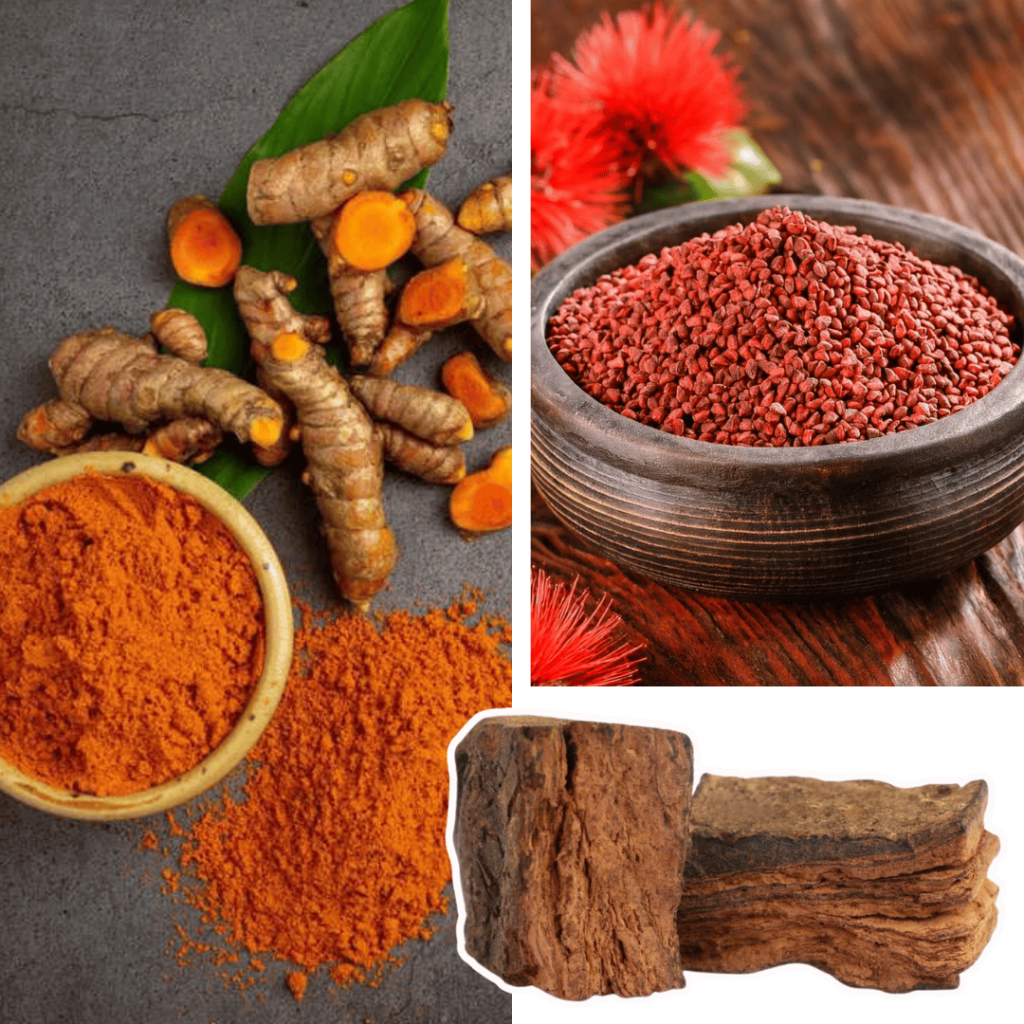
- Catechu (Acacia Tree): The heartwood is boiled to create “Cutch,” yielding sophisticated, earthy browns.
- Turmeric Root: A vibrant, golden yellow that is both sacred and medicinal.
- Annatto Seeds (Bixa orellana): These seeds are nature’s treasure. Their pigment varies from golden saffron to a flaming amber.
- Perspicacity: These seeds are prized for their depth and light-reflecting properties, giving fabrics a warm, sunset-like glow.
- Extraction Process: Unlike flowers, roots and barks require a slow, meticulous boiling process to release their tannins and pigments.
Minerals and Metals
Nature also provides colors through the earth’s crust and the oxidation of metals.
Copper Vessels: Traditional dyeing often takes place in copper or brass vats, which can introduce subtle green undertones through chemical interaction.
Iron Oxide (Ferrous Sulfate): We ferment iron scraps with jaggery to create a liquid that turns fabrics black or charcoal gray.
Alum (Potassium Aluminum Sulfate): A naturally occurring mineral used to fix the color and enhance brightness.
The Essential Role of Mordants
In natural dyeing, color is only half the battle. The other half is the mordant (from the Latin mordere, “to bite”). A mordant is a natural fixative that ensures the dye bonds permanently to the fiber.
Alumina: Used to brighten and “clear” the colors, especially reds and yellows.
Iron: Used to “sadden” or darken a color, turning a bright yellow into a deep olive green.
Myrobalan (Tannins): Derived from the Myrobalan fruit, these tannins are essential for cotton textiles, acting as the primer that allows the dye to adhere.
Without these natural fixatives, colors would wash away. With them, an Anuprerna garment can last for decades, developing a beautiful “patina” rather than simply fading.
Anuprerna’s Sustainable Move—Why It Matters
Unique Aesthetics: No two pieces are identical. The subtle variations in shade and the tiny “cracks” in the Dabu mud create a garment that is truly a one-of-a-kind masterpiece.
Environmental Integrity: No toxic sludge enters our waterways.
Artisan Empowerment: We support the livelihoods of master printers and dye-makers who have passed this knowledge through generations.
Explore Our Naturally Dyed Collections

Conclusion: Joining the Movement
At Anuprerna, we embrace this natural alchemy. By using flowers, leaves, roots, and minerals, we create colors that are safe, authentic, and deeply connected to the earth. We invite you to explore our collections and feel the difference of fabric that has been touched by the sun, the mud, and the soul of the artisan.