

The Elegance of Ketia Silk
Ketia Silk is a prized fabric, revered for its lustrous appearance and graceful drape. Originating from the serene landscapes of India, it is renowned for its luxurious feel. Because of its subtle sheen and fine weave, this silk exudes sophistication. Consequently, it is a coveted choice for both upscale attire and exquisite home furnishings.
As purveyors of fine textiles, Anuprerna stands as a leading provider of Ketia Silk. We offer discerning customers the epitome of elegance. Furthermore, our commitment to craftsmanship ensures that each piece embodies timeless beauty and impeccable style.
Historical Origins:

Silk production first began in China during the Neolithic period. Archaeologists found remnants in the Yangshao culture dating back to the 4th millennium BCE. For a long time, this production remained exclusively confined to China.
However, the advent of the Silk Road eventually allowed the fabric to spread to other regions. Despite this global expansion, China maintained its dominance in silk manufacturing for nearly another thousand years.
A Peace Offer: What is Ketya?
Ketya is a specific variant of Ahimsa silk from West Bengal, India. It is easily distinguished by its raw, textured quality. Specifically, the fabric is made by weaving threads from residual fibers of hatched Tussar silk cocoons. To create a unique finish, artisans blend these fibers with other yarns like Matka silk or Khadi.
The Manufacturing Process
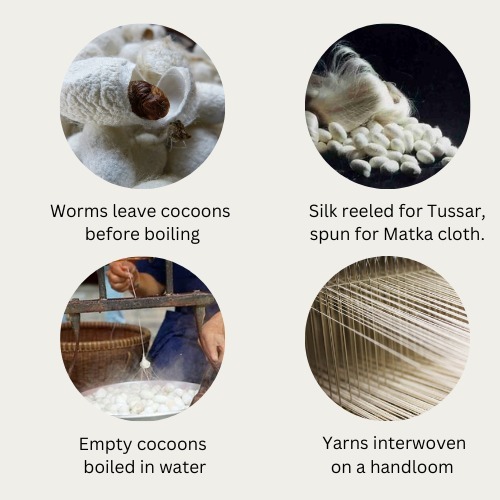
The production of Ketia silk involves several specialized methods, depending on the type of fiber used.
Tussar silk comes from wild silkworms. In this process, the cocoons are boiled to soften the fibers, which makes extraction easier. Notably, if the cocoons are processed after the larvae have left, the result is called “non-violent” or Ahimsa silk.
Matka Silk :
Matka silk is a coarser form of silk from the Indian subcontinent. Usually, it is produced from “pierced” cocoons where the moth has already emerged. Since the continuous thread is broken, the silk must be spun rather than reeled. Interestingly, Matka was historically used by the pious because the process does not kill the insect.
The Construction of Ketia Silk

The creation of Ketia fabric takes place on a traditional handloom. During this process, various threads are interlaced as warp and weft to build the foundation of the textile. Specifically, the warp refers to the vertical threads, while the weft represents the horizontal yarns that cross through them.
In addition to the manual weaving, the unique character of Ketya comes from its blend of materials. Artisans often combine different silk grades to achieve a specific weight and feel. As a result, the fabric acquires its distinctive textured appearance and signature organic hand-feel. Ultimately, this fusion of ancient techniques and raw fibers makes every yard of Ketia silk a masterpiece of handloom art.
Key Construction Terms
Handloom: A manual machine used for weaving that requires high precision from the artisan.
Warp: The set of longitudinal threads held in tension on the loom.
Weft: The transverse thread that is woven through the warp.
Influence in Modern Fashion

Ketia Silk has long been a staple in the world of high fashion. Its natural brilliance and fluidity make it ideal for flowing, high-end garments. Moreover, designers frequently choose it for red-carpet gowns to convey a sense of timeless beauty.
Today, fashion enthusiasts admire Ketia satin for its unmatched quality. It combines a rich, luxurious texture with an effortless, ethereal aura. In short, this refined fabric remains a top choice for those seeking a captivating presence in their wardrobe.
Quick Facts About Silk
Natural Source: Tussar silk is produced by silkworms that eat Asan and Arjun leaves.
Golden Hue: Tussar is famous for its natural golden color, known in Sanskrit as Kosa.
Ethical Roots: Matka silk was once known as the “silk of the poor” because it allowed the insect to live.
Health Benefits: Silk is naturally hypoallergenic and antimicrobial.
Durability: It is considered the strongest natural textile in the world!